
Fusion Fortnightly | 2026-02-17
No fluff, all facts.
A NIF spinout raises a $450M Series A, Helion touts a vague achievement, and I find a private fusion company that beat TAE and General Fusion to the public markets.
Funding
Inertia announced a $450 million Series A financing to commercialize laser-based inertial fusion. Inertia is basically the private company version of the National Ignition Facility (NIF), using laser inertial direct drive. This should come as no surprise, as the co-founders are: Annie Kritcher, who was Lead of Integrated Modeling and Design at the NIF; Mike Dunne, who was the Fusion Energy Program Director at LLNL; and Jeff Lawson, who was named after the Lawson criterion and owns The Onion, “America’s Finest News Source”.
Companies
Helion announced that its Polaris prototype achieved measurable deuterium‑tritium (D‑T) fusion and reached plasma temperatures of 150 million °C (~13 keV). If true, the results would put Helion in the lead for plasma temperature in a non-tokamak fusion device. Without any context on the other plasma conditions, specificly density, energy confinement time, and electron temperture, it is hard to assess what they have accomplished here. It fits with their history of bold claims with little evidence or context. Operating with tritium is a major milestone, but saying that you achieved D-T fusion without any metrics is not a useful statement; there are plenty of particle accelerators that could say the same thing but are not on a path to commercial fusion energy.
In related news, a paper was recently published challenging Helion’s reactor operational point: Comments on the Paper “Fundamental Scaling of Adiabatic Compression of Field Reversed Configuration Thermonuclear Fusion Plasmas”. The authors find that even if Helion was able to heat its D-He3 fueled FRC plasmas to 40-100 keV, the large difference in electron and ion temperatures at those conditions would rapidly cool the ions, significantly reducing fusion power production.
Pacific Fusion reported results from four experiments at Sandia National Laboratories’ Z Pulsed Power Facility measuring magnetic-field diffusion in simplified aluminum-and-plastic targets. This is a critical result for them, as destroying the external magnetic coils as is done on the Z-machine on every MagLIF shot is a non-starter for economic fusion (i.e., the kopec problem).
General Fusion appointed Wendy Kei as a Strategic Advisor to support their move to go public. This is something to keep an eye on for other private fusion companies as an early indicator they are planning on going public: they will be bringing on employees, advisors, and board members with public company experience in areas of finance and governance.
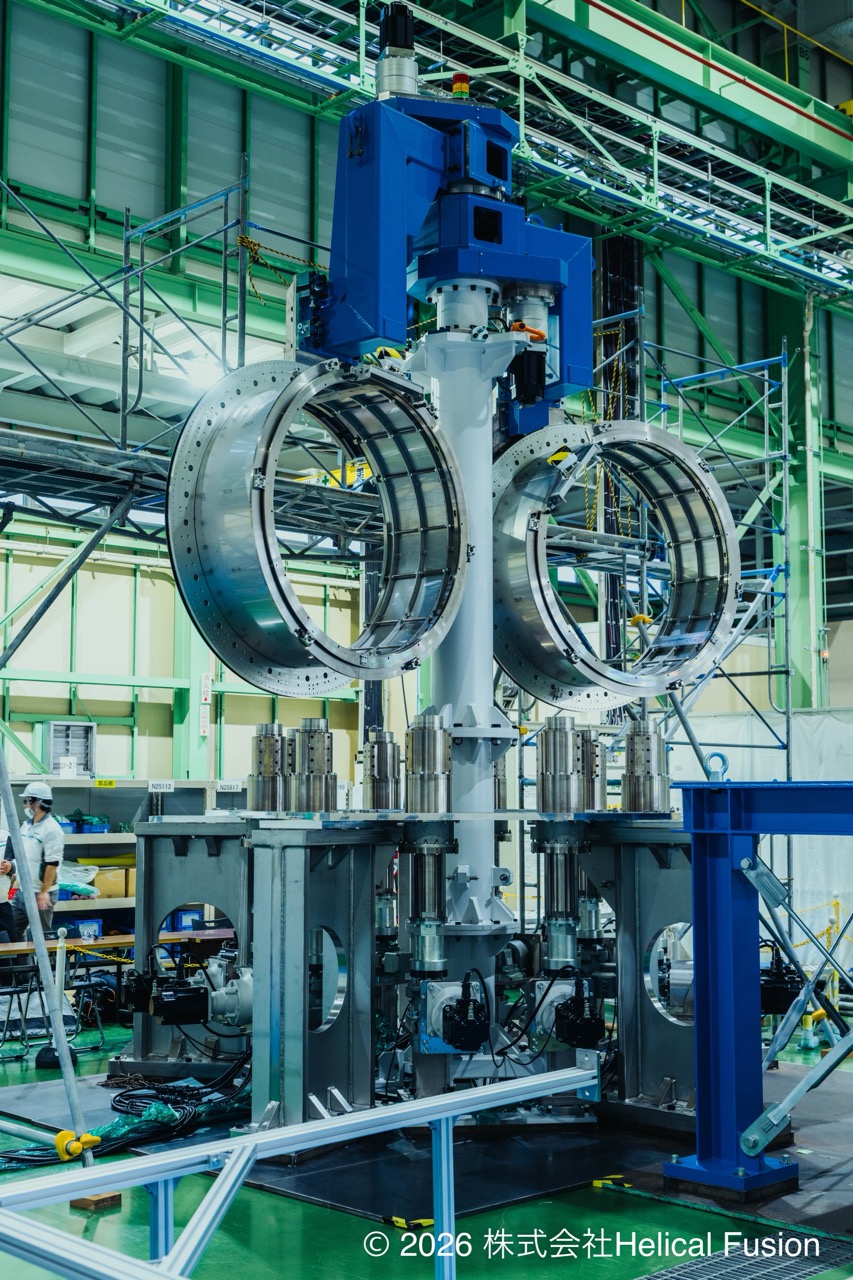
Helical Fusion announced that it completed a coil manufacturing machine, developed with Sugino Machine Limited. This will be used to wind in place the high‑temperature superconducting coils for its integrated demonstration device Helix HARUKA, which, judging by the size of the manufacturing machine suggests the device has a major radius of about 2 m.
Type One Energy releases a video showing their “world’s first non-planar, high-temperature superconducting (HTS) stellarator magnet”. Looks like it has an external coil to it to increase the magnetic field for testing. Probably a simple no-insulation pancake coil for static loads.
I think I found a fusion company that beat TAE and General Fusion to the public markets: The merger between Renewal Fuels (RNWF) and Kepler Fusion Technologies was announced on December 1, 2025. Although I give it an even lower chance of commercial fusion revenue than TAE or General Fusion. Some digging finds that RNWF was in the biodiesel business and then rolled up 6 more companies including ones doing business in financial advisory, cannabis, hemp, and psilocybin. So, it seems there was already a stranger fusion merger on the books than the TAE-TMTG.
Public-Private Partnerships
The New Zealand government announced it will invest up to NZ$35 million (~$21M USD) as a loan via the Regional Infrastructure Fund to support a specialized facility for OpenStar’s next fusion machine.
Fusion for Energy and Gauss Fusion signed a collaboration agreement. “The scope is open-ended and the teams on both sides will be able to exchange knowledge and best practices.”
Government
The U.S. Department of Energy announced the inaugural membership of a new DOE Office of Science Advisory Committee (SCAC), a cross-cutting body that will advise on major Office of Science initiatives including fusion; this is an early signal of which scientific/industrial priorities may get elevated in DOE’s science agenda. Good to see Derek Sutherland, VP of R&D at Realta Fusion, and Tammy Ma, Director of the Livermore Institute for Fusion Technology at LLNL, on the committee representing fusion energy’s interests.
Technology
ENEA reported acceptance testing of a 170 GHz, 1 MW gyrotron for Italy’s DTT program: 1 MW at 170 GHz for 100 seconds and 95% reliability, with follow-on manufacture of additional units under contract. Still waiting on my 300-GHz class gyrotrons for high-field fusion, but this is a solid milestone nonetheless.
Fujikura announced ¥5.6 billion (~$36M USD) in capital investment for production expansion facilities for high-temperature superconductors (HTS), citing expected demand growth tied to fusion energy development.
Microsoft said it is investigating high-temperature superconductors for datacenter power infrastructure, which is emerging as a near-term application for HTS. It does not require the extreme engineering of high-field superconducting magnets and can be much more compact and efficient than copper or low-temperature superconductor power transmission systems.